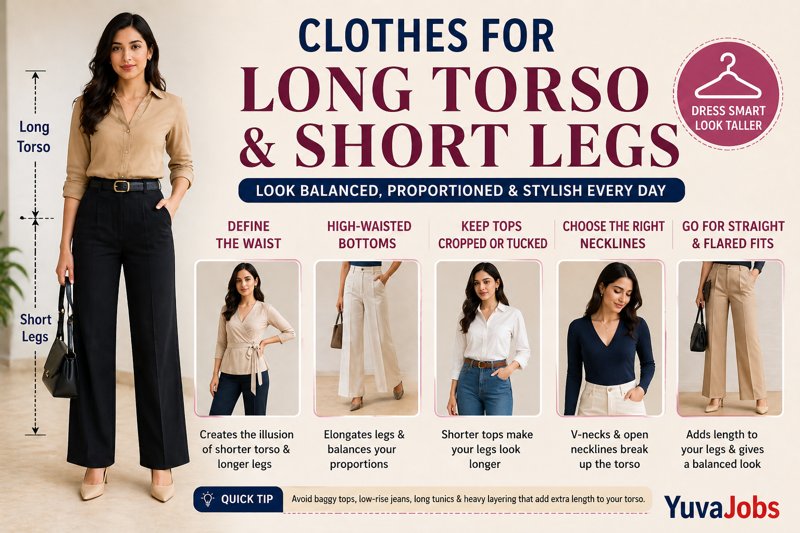

Proportion is the quiet rule behind every outfit that “just works.” You notice it when something feels off, even if you can’t name why. For bodies with a longer torso and comparatively shorter legs, that feeling shows up as tops that seem to dominate and trousers that visually cut height.
Clothes for long torso and short legs aren’t about hiding your shape; they’re about redistributing attention so the eye reads balance. That means changing where the waist appears, how lines travel, and where breaks occur in the outfit. Small shifts — a rise here, a hem there — can alter the whole silhouette.
By the end, you’ll know which cuts, rises, and styling choices consistently create longer-looking legs without sacrificing comfort or personal style.
Background and context
Fashion uses visual cues to suggest proportion. The human eye tends to split the body near the waist, then compares upper and lower halves. When the torso is longer, the natural waist sits lower relative to total height, so standard mid-rise clothing often reinforces that imbalance.
And designers build most ready-to-wear around an “average” ratio. That’s why the same pair of jeans can look balanced on one person and shortening on another. Rise, crotch depth, and waistband placement all change where the eye thinks your legs begin.
But length isn’t only vertical. Horizontal lines — waistbands, hems, cuffs — act like stop signs for the eye (and too many of them on the lower half can compress perceived leg length). Fabric drape matters as well: stiffer materials create sharper breaks, while fluid fabrics extend lines.
So the goal isn’t to chase trends. It’s to control visual starting points, reduce interruptions, and extend continuous lines from waist to floor.
The main substance
Start with the waist. High-rise bottoms (10–12 inch rise in many women’s ranges, slightly lower in menswear depending on brand) physically lift where the legs “begin.” That one change can add several perceived centimeters. Look for styles labeled high-rise, super high-rise, or tailored trousers with a defined waistband — the structure helps the illusion hold.
And pay attention to where tops end. Cropped or waist-length tops work because they don’t drag the eye downward. Longer tops can still work, but only if you tuck or half-tuck to reveal the higher waist. A long untucked shirt creates a continuous block that extends the torso visually — the exact opposite of what you want.
But not all trousers are equal. Straight-leg and slight flare cuts lengthen because they keep a consistent line from hip to hem. Wide-leg styles can also work if the fabric is fluid and the rise is high; otherwise, excess volume near the hips shortens the look. Skinny fits can be fine, yet they often emphasize where the leg actually begins, so the rise matters even more.
Shoes matter more than people expect. Pointed toes extend the line; low-contrast shoes (close to your trouser color or your skin tone) avoid a harsh break at the ankle. And ankle straps, thick cuffs, or heavy contrast socks interrupt the line — use them sparingly.
Skirts and dresses follow the same logic. High-waisted skirts worn above the natural waist visually relocate it. A-line shapes elongate, while drop-waist dresses push the waistline lower and lengthen the torso — not ideal here. Midi lengths can work if the hem falls at a narrow part of the calf and pairs with shoes that don’t cut the line.
Here’s the thing: details accumulate. A high rise with a tucked top, a clean hem, and a low-contrast shoe can transform proportion even if each change seems small on its own.
Practical angle
Shopping becomes easier when you filter by construction first. Check the rise measurement before anything else. If it’s mid-rise, assume you’ll need to style around it; if it’s high-rise, you’ve already solved half the problem.
And in fitting rooms, look at yourself from a distance (a mirror several steps back or a quick photo). Close-up views hide proportion issues. You’re judging the whole silhouette — where the eye starts, where it stops, and how smoothly it travels.
Tailoring can be the quiet fix. Hemming trousers to remove pooling at the ankle preserves a clean line. Adjusting waistbands to sit slightly higher (where fabric allows) can refine the effect without buying new pieces.
But there’s a caveat. Body proportions vary beyond a simple long-torso/short-legs label (hip placement, rise comfort, and personal style all play a role), so not every “rule” will feel right in practice. Use these as levers, not rigid instructions.
What to know going forward
Proportion is adjustable. The same body can read completely differently depending on where the waist appears and how continuous the leg line looks.
And consistency beats perfection — a few aligned choices (higher rise, shorter top, uninterrupted line) usually outperform a single dramatic piece.
Or think in terms of starting points. If you can move the visual waist up even slightly and reduce breaks below it, you’re already improving the balance.
So build outfits from the waist outward: choose the rise, decide the top length, then keep the leg line clean down to the shoe.
Closing
Clothes for long torso and short legs don’t require a new wardrobe. They require attention to where lines begin and end. When you control those points, outfits stop fighting your proportions and start working with them.
Next step: take one outfit you already own and adjust just two things — raise the waist visually and remove one break in the leg line. The change is often immediate, and it teaches more than any guideline on paper.