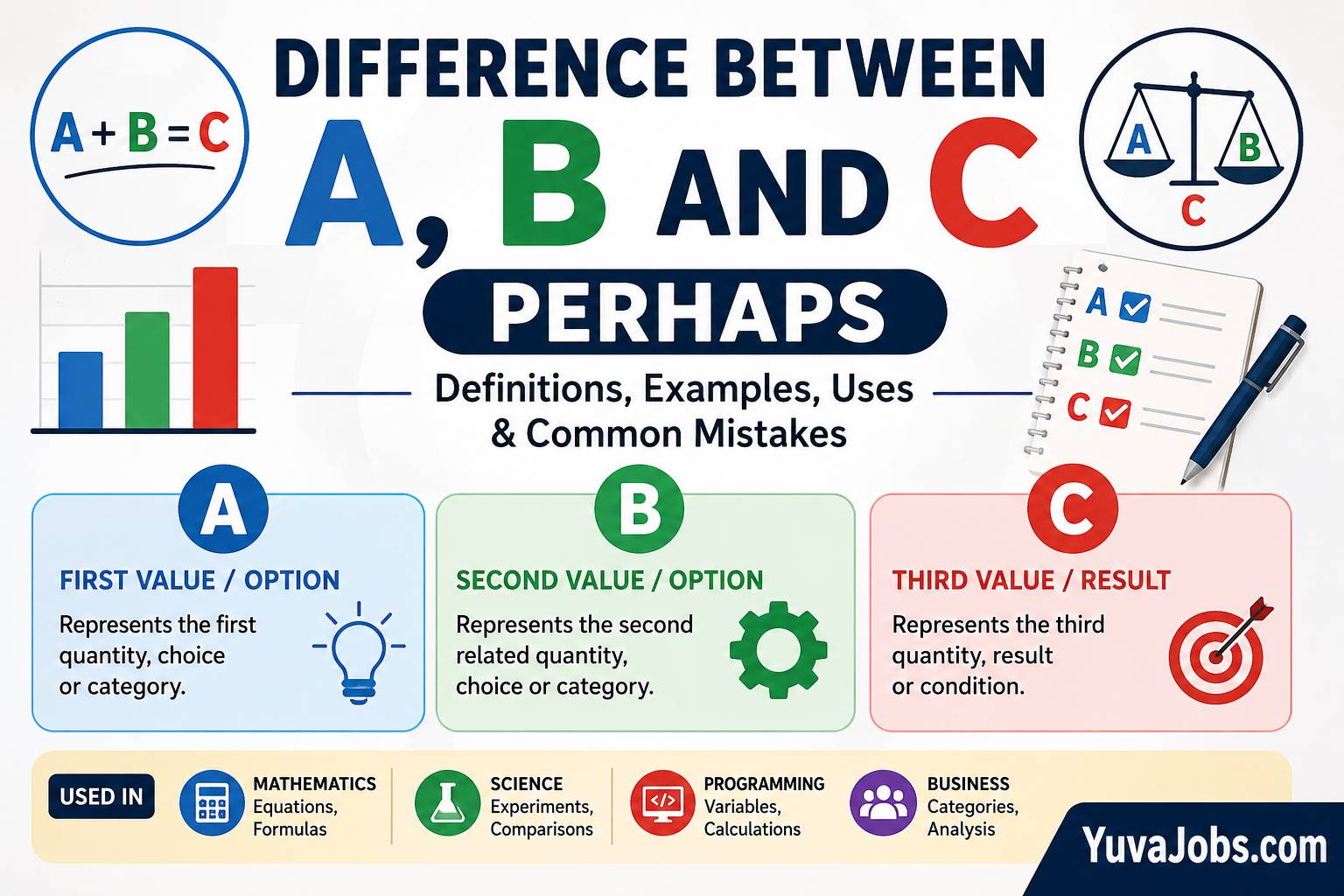

Difference Between A, B and C Perhaps: Understanding How Variables and Choices Are Compared
A small letter can completely change the meaning of a problem. Many students first see symbols like A, B, and C in mathematics, science, reasoning questions, or programming and assume they are just random labels. The difference between A, B and C perhaps depends on the context where these symbols appear, but the deeper idea is comparison: understanding what each element represents and how it relates to the others.
By the end of this guide, you will understand how A, B, and C are used as variables, categories, options, and values. You will also learn how to avoid the common mistakes that appear in exams and practical situations.
Core Concept and Definition of A, B and C Differences
Letters such as A, B, and C become meaningful because they represent something else. In mathematics, they commonly work as variables, which means symbols that can hold different values depending on the problem. In another subject, they may represent choices, groups, grades, objects, or conditions.
A variable is a symbol used to represent an unknown or changing quantity. For example, in the equation A + B = C, the letters are not alphabet characters anymore. They represent quantities connected through a mathematical relationship.
But context decides everything.
A, B, and C in an algebra equation are different from A, B, and C options in a multiple-choice exam. In algebra, their values are usually calculated. In classification systems, they may identify different groups (such as category A, category B, and category C). This distinction matters because students often try to apply one meaning everywhere — and that creates confusion.
And this is why textbooks, competitive exams, and technical fields always define symbols before using them.
For example:
The exact interpretation depends on the subject area (which is why reading the given information carefully matters).
Deep Explanation With Examples of A, B and C
Understanding A, B, and C becomes much easier when you see them working inside real examples. Symbols are not the difficult part. The relationship between symbols is where learning happens.
Consider this basic algebra example:
A = 5
B = 10
Find C if:
A + B = C
Step 1: Replace the letters with given values.
5 + 10 = C
Step 2: Calculate the result.
15 = C
So C equals 15.
Here, A and B are input values, while C is the output value. The formula shows their connection. Changing A or B will automatically change C.
Now imagine another example:
A = length
B = width
C = area
For a rectangle:
C = A × B
If:
A = 8 cm
B = 4 cm
Then:
C = 8 × 4
C = 32 square cm
The letters are different, but the thinking process remains the same — identify what each symbol represents before solving.
And sometimes A, B, and C are not numbers at all.
Example from a reasoning test:
A = Beginner level
B = Intermediate level
C = Advanced level
Here, there is no calculation. The difference is based on classification. A person at level C is not “larger” mathematically than a person at level A; they simply belong to another category.
But students often mix these situations. They see letters and immediately search for formulas, even when the question is asking for comparison or explanation.
Here’s the thing: the real skill is not memorising what A, B, and C mean. The skill is learning how to decode their meaning from the situation.
Another useful example comes from programming:
A = 20
B = 30
C = A + B
The computer stores values in variables and calculates:
C = 50
A programmer could later change A to 40, and the final result would also change. This shows the purpose of variables: they make systems flexible.
However, there is a limitation. Letters alone do not provide enough information. If someone simply writes “find the difference between A, B and C” without explaining the subject, there may not be one correct answer. Extra details are required to know whether they are numbers, groups, choices, or labels.
Real-World Applications of Understanding A, B and C
These simple-looking symbols appear in many real situations because they make information easier to organise. Students meet them in school exams, competitive tests, science problems, computer programming, and data analysis.
In mathematics exams, A, B, and C may represent unknown values inside formulas. For example, quadratic equations often use letters to represent coefficients:
ax² + bx + c = 0
In this case, a, b, and c are fixed numbers that affect the shape and solution of the equation.
So the same letters can have a completely different purpose depending on the chapter.
In science experiments, variables are also compared. One condition may be labelled A, another B, and another C. Researchers then observe differences in results. This makes experiments easier to track — especially when many items are being tested.
Businesses also use categories like A, B, and C. For example, ABC analysis in inventory management divides items based on importance and value. Category A items usually receive the highest attention because they have the greatest impact.
The truth is, these letters continue appearing because they are simple, flexible, and internationally understood.
Common Mistakes and Misconceptions About A, B and C
Many learners struggle because they treat every symbol as having a permanent meaning. A does not always mean the first number. C does not always mean the answer. The question decides the role.
One common mistake is assuming alphabetical order means value order.
For example:
A = 100
B = 20
C = 5
Here, A is greater than C. But another question could define:
A = 1
B = 50
C = 200
Now C is greater.
Or the letters may not represent size at all.
Another mistake happens when students ignore units. If A represents distance and B represents time, adding them directly may make no sense. Correct formulas depend on compatible quantities.
A third misunderstanding appears in multiple-choice questions. Some students think option C is somehow more likely because they notice patterns from previous exams. Realistically, answer labels are only identifiers and should not influence problem-solving.
Good learners always ask: “What does this symbol represent here?”
That single habit prevents many errors.
What to Study Next After Learning A, B and C Differences
Understanding the difference between A, B and C perhaps is really about understanding symbols, relationships, and context. Once you become comfortable with this idea, study variables, algebraic expressions, formulas, and logical reasoning patterns.
Practise by taking simple equations and changing the values of A, B, and C yourself. Watch how the result changes.
The next useful step is learning dependent and independent variables because that explains why changing one value can affect another. Master that concept, and many maths, science, and technical problems become much easier to understand.