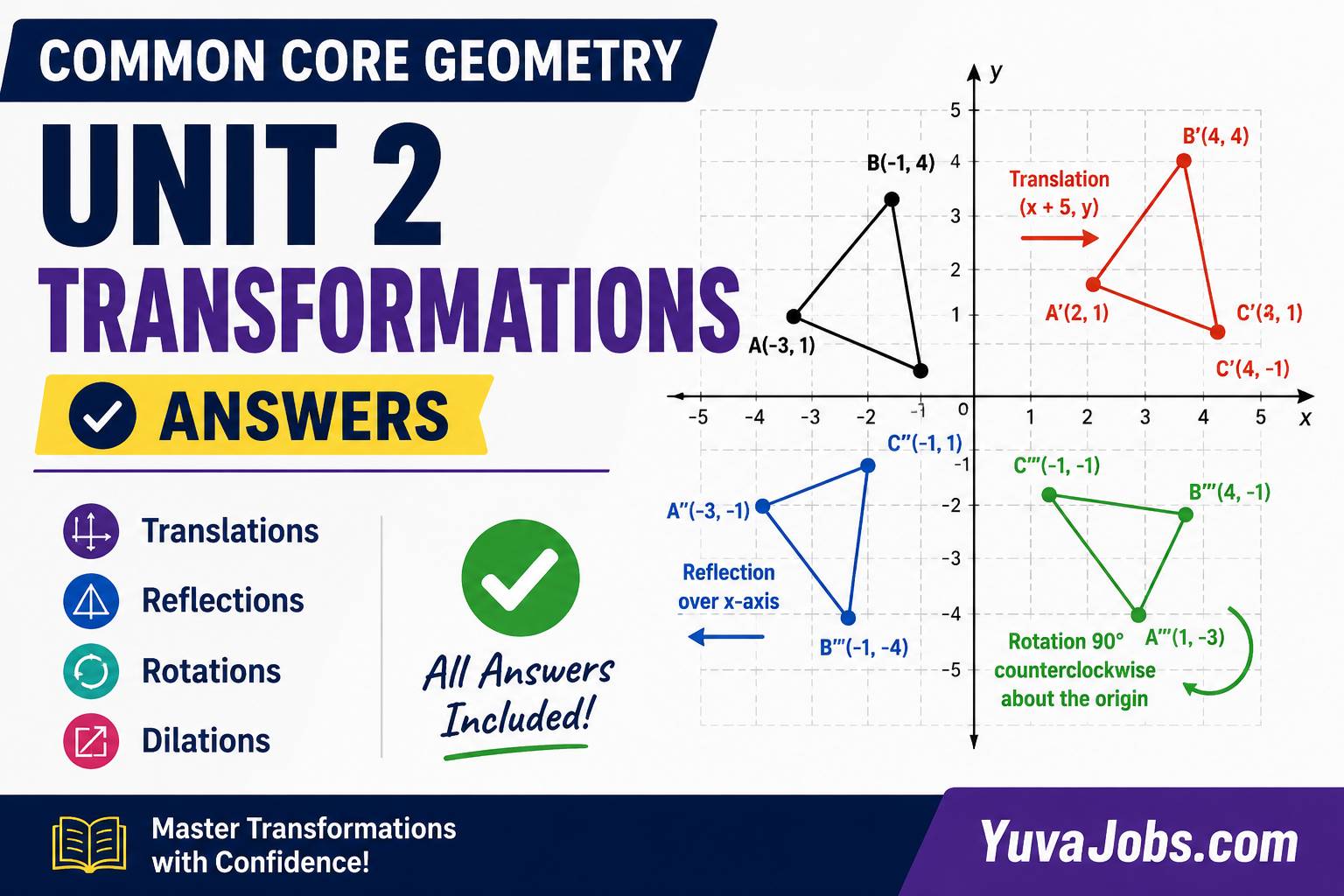
Geometry often feels like a subject about shapes, lines, and measurements. Yet one of the most powerful ideas in the entire course is movement. Instead of asking what a figure looks like, transformations ask what happens when that figure slides, flips, turns, or changes size. That shift in thinking is exactly why so many students spend extra time searching for common core geometry unit 2 transformations answers. The challenge is rarely the final answer itself. The real difficulty comes from understanding the rules behind each transformation and applying them correctly.
By the end of this article, you will understand the major transformation concepts covered in Common Core Geometry Unit 2, learn how to solve typical problems step by step, recognize common mistakes before they happen, and see how these ideas connect to both exams and real-world applications.
Why Transformations Matter in Geometry
A transformation changes the position, orientation, or size of a figure according to a specific rule. In Common Core Geometry Unit 2, students typically study four major transformations:
- Translations
- Reflections
- Rotations
- Dilations
Three of these preserve size and shape exactly. These are called rigid transformations. Dilations change size while maintaining proportional relationships, making them non-rigid transformations.
The purpose of studying transformations goes far beyond moving points on a coordinate plane. Transformations provide the foundation for understanding congruence and similarity. When one figure can be transformed into another through rigid transformations, the figures are congruent. When a dilation is involved, the figures may be similar.
And that idea becomes a major building block for later geometry topics.
A translation slides a figure without rotating or flipping it. Every point moves the same distance in the same direction.
A reflection creates a mirror image across a line called the line of reflection.
A rotation turns a figure around a fixed point called the center of rotation.
A dilation enlarges or reduces a figure using a scale factor measured from a center point.
These definitions may seem straightforward, but students often struggle because they try to memorize procedures rather than understand what each movement actually does to coordinates and distances.
Deep Explanation with Worked Examples
The fastest way to understand transformations is to work through actual coordinate examples.
Example 1: Translation
Suppose point A is located at (2, 3).
The transformation rule is:
(x, y) → (x + 4, y − 2)
Apply the rule:
x-coordinate: 2 + 4 = 6
y-coordinate: 3 − 2 = 1
The image of point A is:
A’ = (6, 1)
Notice what happened. The point moved 4 units right and 2 units down. No rotation occurred. No change in shape occurred. Distances remain identical.
So translations preserve both angle measures and side lengths.
Example 2: Reflection Across the x-Axis
Take point B = (5, 4).
Reflection rule:
(x, y) → (x, −y)
Apply the rule:
B’ = (5, −4)
The x-coordinate stays unchanged because the point remains the same distance from the y-axis.
The y-coordinate changes sign because the point moves to the opposite side of the x-axis.
Students frequently remember this more easily by visualizing a mirror placed along the x-axis.
Example 3: Reflection Across the y-Axis
Point C = (−3, 7)
Rule:
(x, y) → (−x, y)
Apply the rule:
C’ = (3, 7)
Only the x-coordinate changes sign.
This pattern appears repeatedly on quizzes and standardized tests.
Example 4: Rotation 90° Counterclockwise About the Origin
Point D = (4, 1)
Rule:
(x, y) → (−y, x)
Substitute values:
D’ = (−1, 4)
Students often confuse clockwise and counterclockwise rules. Here’s the thing: drawing a quick sketch usually prevents costly errors.
For reference:
90° Counterclockwise:
(x, y) → (−y, x)
90° Clockwise:
(x, y) → (y, −x)
180° Rotation:
(x, y) → (−x, −y)
Even advanced students occasionally mix these formulas up during timed exams.
Example 5: Dilation
Suppose point E = (2, 5).
Scale factor = 3
Center of dilation = origin
Rule:
(x, y) → (3x, 3y)
Substitute:
E’ = (6, 15)
Every coordinate is multiplied by the scale factor.
When the scale factor is greater than 1, the figure enlarges.
When the scale factor is between 0 and 1, the figure shrinks.
A scale factor of 1 leaves the figure unchanged.
And unlike rigid transformations, dilations alter side lengths while preserving shape.
Combining Transformations
Many Unit 2 problems involve multiple transformations.
Imagine a triangle undergoes:
- Translation 3 units right
- Reflection across the x-axis
Starting point:
P = (1, 2)
Step 1:
(1 + 3, 2)
P₁ = (4, 2)
Step 2:
(4, −2)
Final image:
P’ = (4, −2)
Order matters.
If you reflect first and then translate, the final coordinates may be different. This concept (often overlooked during homework assignments) becomes increasingly important in higher-level mathematics.
Real-World Applications of Transformations
At first glance, transformations can seem like exercises designed only for geometry class. The reality is much different.
Computer graphics rely heavily on transformations. Every time a character moves across a video game screen, translations are being used. When objects spin, rotations control the movement. Scaling effects depend on dilations.
Architecture also uses transformation principles. Building designs often include symmetrical elements created through reflections and rotations. Engineers use transformation concepts to maintain consistency across complex structures.
Medical imaging provides another example. Doctors examining MRI and CT scans frequently work with images that have been rotated, reflected, or scaled to improve analysis and comparison.
And transformations appear constantly on standardized exams. Questions involving congruence, similarity, symmetry, coordinate geometry, and proofs often depend on understanding transformation rules.
The truth is that students who genuinely understand transformations usually perform better across multiple geometry units because these ideas connect to many later topics.
There is one caveat, though. Real-world software performs these operations using matrix mathematics and more advanced techniques than those covered in Unit 2. Geometry class focuses on the conceptual foundation rather than the full computational methods.
Common Mistakes and Misconceptions
Many incorrect answers come from a small set of predictable mistakes.
One frequent error occurs during reflections.
Students may change both coordinates when reflecting across a single axis.
For example:
(3, 5)
Reflected across the x-axis should become:
(3, −5)
Only the y-coordinate changes.
Another common mistake appears in rotations.
Students memorize coordinate rules but apply the wrong one under pressure. A quick sketch of the coordinate plane often reveals whether the answer makes sense before submitting it.
Dilations create a different problem.
Some students assume side lengths remain unchanged because translations, reflections, and rotations preserve size. But dilations intentionally change size. A scale factor of 2 doubles all distances from the center of dilation.
Negative coordinates also create confusion.
For instance, when applying:
(x, y) → (−x, y)
to point (−4, 6),
the image becomes:
(4, 6)
The negative sign changes the coordinate’s sign; it does not simply get added.
But perhaps the biggest misconception involves congruence and similarity.
Rigid transformations prove congruence because they preserve size and shape.
Dilations produce similarity because shape remains proportional while size changes.
Recognizing this distinction helps students answer many geometry proof questions correctly.
What to Practice Next
Mastering transformations requires repetition, but productive repetition matters more than completing dozens of nearly identical problems. Focus on identifying the transformation first, then apply the correct coordinate rule, and finally check whether distances and orientations make sense. Practice translating figures, reflecting them across different axes, rotating them about the origin, and performing dilations with various scale factors. After that, move on to sequences of transformations involving two or more steps. Once those skills feel comfortable, topics like congruence, similarity, and geometric proofs become much easier to understand and solve accurately.
