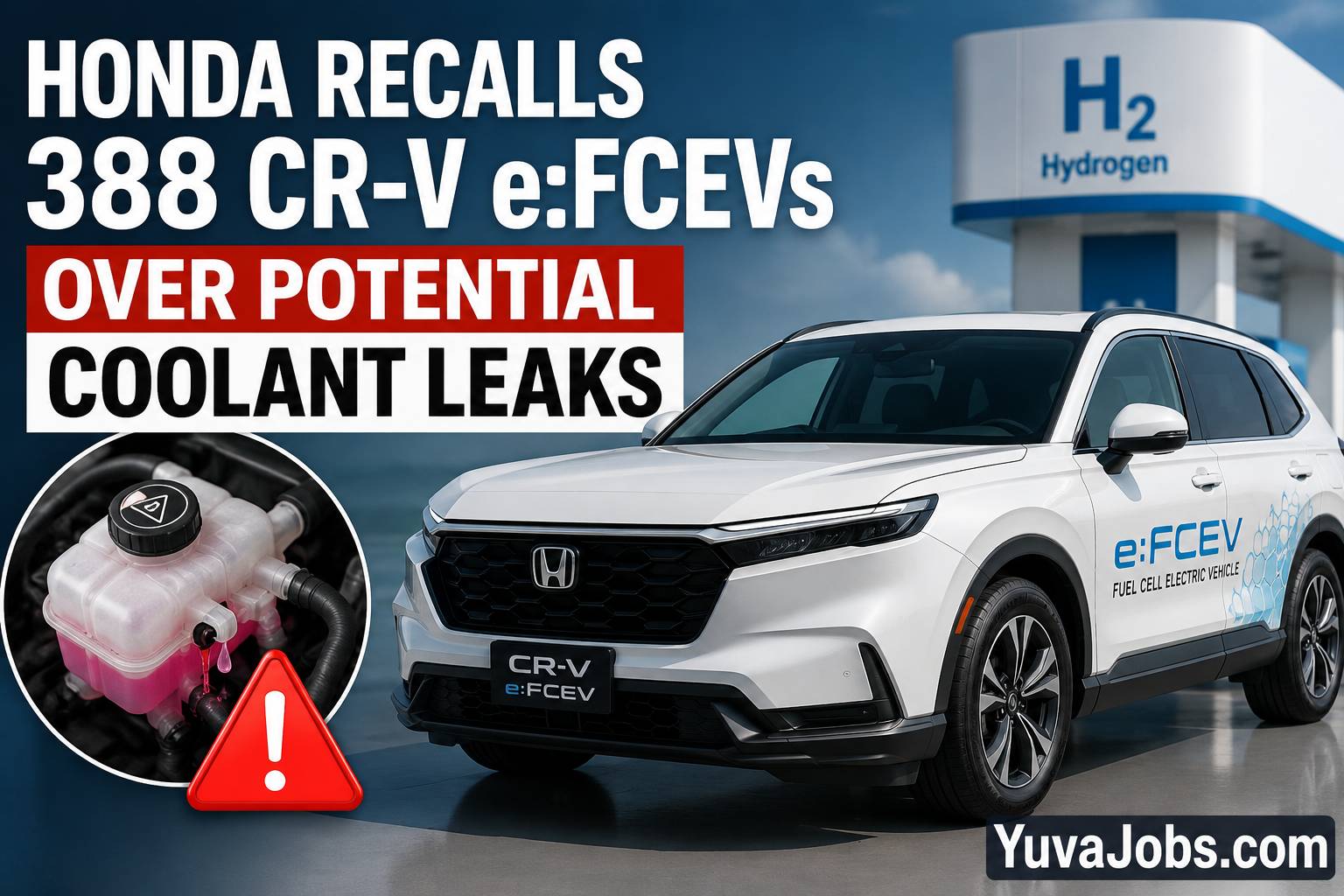
A vehicle recall rarely affects only the owners receiving the notification. It often becomes a window into something larger: how automakers handle emerging technology, manufacturing quality, and long-term reliability. That is exactly why the news that Honda is recalling 388 CR-V e:FCEVs for potential coolant leaks deserves attention beyond the small number of vehicles involved.
For shoppers considering fuel-cell vehicles, battery-electric vehicles, or even plug-in hybrids, recalls provide valuable clues about the real-world ownership experience. They reveal where engineering challenges still exist and how manufacturers respond when problems emerge. The Honda CR-V e:FCEV occupies a unique place in the market, combining hydrogen fuel-cell technology with plug-in charging capability, making it one of the most unusual vehicles currently available.
By the end of this article, you’ll understand what this recall means, how serious the issue appears to be, how it compares with reliability concerns seen in competing alternative-fuel vehicles, and what current or prospective owners should realistically expect.
Why This Recall Matters More Than the Number Suggests
A recall involving just 388 vehicles might sound insignificant at first glance. Yet small recalls can sometimes tell us more than mass-market recalls because they often involve specialized technologies where production volumes are limited.
The CR-V e:FCEV represents one of Honda’s most ambitious engineering projects. Unlike a conventional hybrid or battery-electric model, it combines hydrogen fuel-cell systems, high-pressure hydrogen storage, electric propulsion, and plug-in charging capabilities into a single vehicle.
That complexity creates unique reliability considerations.
When evaluating any alternative-fuel vehicle, the real question isn’t whether a recall happens. Almost every manufacturer experiences recalls at some point. What separates a reassuring ownership experience from a frustrating one is how isolated the issue is, how quickly it is identified, and whether it points to a broader engineering weakness.
And that’s where this recall becomes interesting.
A coolant leak in a fuel-cell system is not equivalent to a cosmetic defect or a software annoyance. Thermal management plays a central role in fuel-cell operation. Maintaining proper temperatures helps preserve efficiency, performance, and durability over time. A leak has the potential to affect those systems if left unaddressed.
But context matters.
The relatively small number of affected vehicles suggests Honda may have identified a specific manufacturing or component-related issue rather than a widespread design flaw. Owners should still take recall notices seriously, yet the available information does not automatically indicate a systemic problem with the entire CR-V e:FCEV program.
Here’s the thing: early-production advanced vehicles often reveal minor issues that only become visible after real-world use. The important factor is whether the manufacturer responds quickly and transparently.
The Options: How Honda’s Situation Compares with Other Alternative-Fuel Vehicle Challenges
Choosing among alternative-fuel vehicles has never been simple. Every technology comes with strengths, compromises, and occasional reliability concerns.
The Honda CR-V e:FCEV offers a particularly distinctive proposition. Drivers receive electric driving capability for daily commutes while retaining hydrogen fuel-cell functionality for extended range. That flexibility can reduce range anxiety in situations where charging infrastructure or hydrogen stations are limited.
The strength of Honda’s approach lies in diversification. Owners are not entirely dependent on one energy source. And for some drivers, that hybridized approach may feel more practical than relying exclusively on battery charging.
However, the tradeoff is complexity.
A battery-electric vehicle such as those offered by major EV manufacturers eliminates hydrogen systems altogether. Fewer propulsion components can sometimes mean fewer potential failure points. Yet battery-electric vehicles face their own challenges, including battery degradation concerns, charging availability issues, software recalls, and thermal management problems.
Toyota’s hydrogen fuel-cell strategy provides another comparison point. Vehicles such as the Mirai focus exclusively on hydrogen operation rather than combining hydrogen and plug-in capabilities. This simplifies some aspects of system integration while creating greater dependence on hydrogen infrastructure.
Then there are plug-in hybrids. They remain attractive because they blend gasoline backup with electric driving capability. For many consumers, plug-in hybrids offer a lower-risk transition into electrification. But they introduce dual-system maintenance requirements and can become mechanically complex over time.
Realistically, no technology category is immune from recalls.
Battery-electric vehicles have experienced battery-related recalls. Plug-in hybrids have seen charging-system recalls. Hydrogen vehicles occasionally encounter issues involving fuel-cell support systems, sensors, or thermal management components.
The truth is that advanced propulsion technologies are still evolving. Manufacturers are learning from real-world data as these vehicles accumulate miles in diverse climates and driving conditions.
One limitation worth acknowledging is that long-term reliability data for the CR-V e:FCEV remains limited. Production numbers are relatively small compared with mainstream vehicles, making it difficult to draw broad conclusions about ownership experiences five or ten years into the future.
That doesn’t make the vehicle risky. It simply means buyers should recognize that the available evidence base is smaller than what exists for established gasoline models.
Side-by-Side Comparison of Alternative-Fuel Vehicle Ownership Considerations
| Vehicle Type | Primary Energy Source | Infrastructure Dependency | System Complexity | Typical Recall Areas | Best For |
|---|---|---|---|---|---|
| Honda CR-V e:FCEV | Hydrogen + Plug-In Electric | Hydrogen Stations and Charging | Very High | Fuel Cell Systems, Cooling Components, Software | Early adopters wanting flexibility |
| Hydrogen Fuel-Cell Vehicle | Hydrogen | Hydrogen Stations | High | Fuel Delivery, Sensors, Thermal Management | Drivers with reliable hydrogen access |
| Battery-Electric Vehicle | Electricity | Charging Network | Moderate | Battery Systems, Charging Hardware, Software | Most urban and suburban commuters |
| Plug-In Hybrid | Electricity + Gasoline | Charging Optional | High | Charging Components, Hybrid Systems | Drivers seeking maximum flexibility |
| Traditional Hybrid | Gasoline + Electric Assist | Minimal | Moderate | Battery Management, Electronics | Reliability-focused buyers |
Who Should Pick What
If you’re specifically interested in cutting-edge propulsion technology and have access to hydrogen infrastructure, the Honda CR-V e:FCEV remains one of the most intriguing choices available. The combination of plug-in charging and hydrogen capability offers flexibility that few competitors can match.
If reliability history matters more than innovation, a traditional hybrid remains difficult to beat. Years of real-world data provide confidence that newer technologies simply cannot match yet.
For drivers who have dependable home charging and rarely travel beyond charging-network coverage, battery-electric vehicles often deliver the simplest day-to-day ownership experience. Charging overnight becomes routine, and maintenance requirements can be relatively low.
But if long road trips, uncertain charging access, or changing travel patterns are part of your lifestyle, a plug-in hybrid often strikes the most practical balance. You gain electric driving for daily use without becoming dependent on charging stations for every journey.
Or perhaps you’re simply evaluating whether the Honda recall should affect a purchase decision. In that case, the available evidence suggests caution rather than alarm. A targeted recall addressing a specific issue is very different from a widespread reliability crisis.
Final Thoughts
The recall affecting 388 Honda CR-V e:FCEVs for potential coolant leaks highlights both the promise and complexity of emerging vehicle technologies. Owners should complete the recall repair promptly, but the limited scope of the issue does not automatically signal a broader problem with the vehicle.
For prospective buyers, the decision should focus less on this individual recall and more on whether hydrogen infrastructure, plug-in charging convenience, and advanced technology align with your needs. The next step is simple: evaluate how you actually drive every week, then compare that reality against the strengths and compromises of each alternative-fuel option before making a commitment.
