Most security failures are not caused by a single mistake. They happen when several small weaknesses line up at the wrong time. A door is left unlocked, an employee clicks a fake email, and outdated software gives an attacker a way inside. That chain of events explains why security professionals rarely rely on just one protective measure.
When people search for at what three levels is security handled, they usually want the simple answer for an exam or interview. The deeper answer is far more useful because these three levels work together rather than independently. Whether the setting is a business office, a hospital, a school, a bank, or a government organization, effective security depends on physical protection, administrative controls, and technical safeguards. Understanding how these layers interact makes the concept much easier to remember—and far easier to apply in real situations.
Why these three levels matter
Security is strongest when every layer supports the others instead of trying to solve every problem alone.
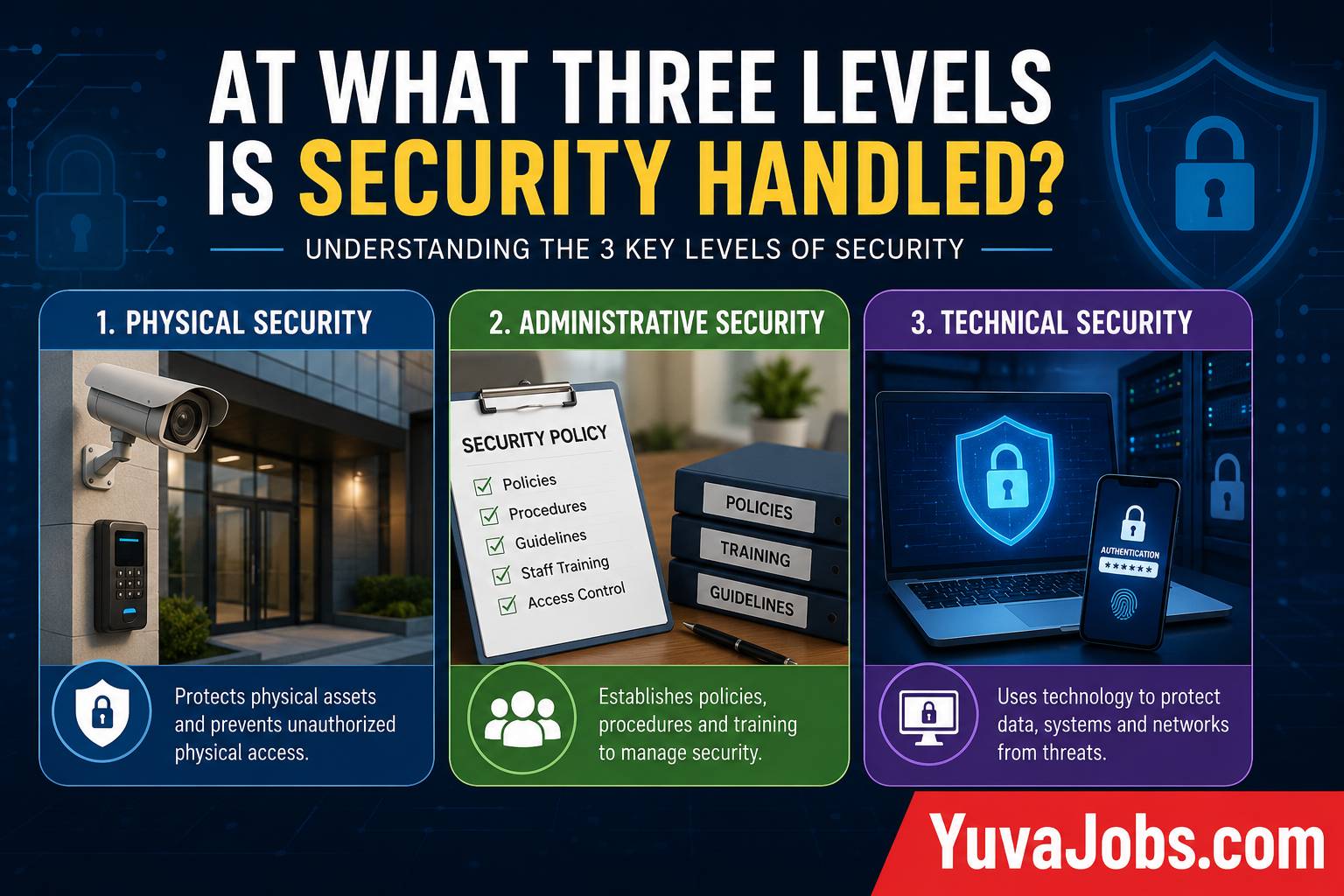
Many textbooks, cybersecurity courses, and information security frameworks describe security through three broad levels:
- Physical security
- Administrative (or procedural) security
- Technical (or logical) security
Each level addresses different types of risks. Physical security protects assets from unauthorized physical access. Administrative security focuses on people, policies, and processes. Technical security uses technology to defend systems, networks, and digital information.
And this layered approach exists because attackers rarely follow just one path. Someone attempting to steal confidential information might first enter a building, persuade an employee to reveal credentials, and only then exploit a software weakness.
Think of these three levels as overlapping circles rather than separate boxes—they constantly reinforce one another.
Without policies, even excellent technology can be misused.
Without physical protection, expensive security systems may be bypassed.
Without technical controls, sensitive information remains exposed despite locked buildings and written procedures.
Understanding the three levels of security in depth
1. Physical security
Every digital system ultimately exists somewhere in the physical world. Servers sit inside data centers. Employees work in offices. Network equipment is installed in buildings.
Physical security protects these resources from theft, damage, sabotage, and unauthorized access.
Common examples include:
- Locked doors
- Security guards
- CCTV surveillance cameras
- Biometric entry systems
- Smart access cards
- Visitor registration procedures
- Security fencing
- Alarm systems
- Fire detection and suppression systems
Imagine a company with excellent cybersecurity software but an unlocked server room. Anyone could remove storage drives, connect unauthorized devices, or damage hardware within minutes.
Realistically, physical security is often overlooked because people associate “security” only with computers. Yet many successful attacks begin with physical access.
Even environmental controls matter (especially inside data centers). Proper cooling systems, backup power supplies, and fire protection help maintain both safety and system availability.
2. Administrative security
Technology cannot compensate for poor decision-making.
Administrative security focuses on the rules, responsibilities, training, and management practices that reduce security risks.
Examples include:
- Security policies
- Password policies
- Employee background verification
- Acceptable use policies
- Security awareness training
- Incident response plans
- Risk assessments
- Vendor management
- Employee onboarding procedures
- Employee offboarding procedures
Suppose an employee leaves an organization. Administrative procedures should require IT staff to disable accounts immediately, recover company devices, and revoke building access.
Without those procedures, former employees might retain access long after leaving.
And security awareness training remains one of the most effective administrative controls. Employees who recognize phishing emails, suspicious phone calls, or social engineering attempts can prevent incidents before technology becomes involved.
Here’s the thing: many organizations spend heavily on software while investing too little in employee education. Human error continues to be one of the leading causes of security incidents because attackers know people can sometimes be easier to manipulate than computers.
3. Technical security
Technical security uses hardware and software to defend digital resources.
These controls protect confidentiality, integrity, and availability of information.
Examples include:
- Firewalls
- Antivirus software
- Multi-factor authentication (MFA)
- Encryption
- Intrusion detection systems
- Intrusion prevention systems
- Endpoint detection and response tools
- Network segmentation
- Secure authentication systems
- Data backups
- Virtual Private Networks (VPNs)
- Security monitoring platforms
Consider online banking.
Your password represents one technical control.
A one-time verification code sent to your phone adds another.
Encrypted communication protects information while it travels across the internet.
Fraud detection systems monitor unusual account activity.
Together, these technologies significantly reduce the chances of unauthorized access.
But technical controls have limits. A firewall cannot stop an employee from intentionally sharing confidential information. That requires administrative controls. Likewise, encrypted servers can still be stolen if physical security fails.
How the three levels work together
The three levels become much easier to understand when viewed as a complete system.
Imagine a hospital storing patient records.
Physical security limits access to server rooms using key cards, surveillance cameras, and security personnel.
Administrative security establishes privacy policies, employee training, access approval procedures, and compliance requirements.
Technical security encrypts patient records, requires multi-factor authentication, monitors network activity, and regularly updates software.
Each layer compensates for weaknesses in another.
Suppose someone enters the building.
Physical security may slow them down.
Administrative procedures determine whether they should have access at all.
Technical controls prevent access to electronic records without valid credentials.
So even if one layer fails, another continues protecting sensitive information.
This concept is known as defense in depth, a widely accepted cybersecurity strategy that relies on multiple protective layers rather than a single barrier.
Why students are often asked this question
Many competitive exams, certification programs, and computer science courses ask:
“At what three levels is security handled?”
The expected answer is usually straightforward:
- Physical security
- Administrative (procedural) security
- Technical (logical) security
Some educational materials may use slightly different terminology.
For example:
- Operational security instead of administrative security
- Logical security instead of technical security
- Personnel security as a separate category
That does not necessarily mean one source is wrong. Different frameworks organize security controls differently depending on their purpose. The underlying ideas remain very similar, even when the names change.
This is one limitation students should remember: always answer according to the textbook, certification guide, or instructor being used.
Applying these concepts in real situations
Knowing the three levels is only the beginning. Applying them makes the knowledge valuable.
Suppose you run a small business.
Physical security could include locking office equipment after hours, installing cameras, and protecting networking hardware.
Administrative security might involve creating password rules, limiting access based on job roles, training employees about phishing emails, and documenting backup procedures.
Technical security would include antivirus software, automatic operating system updates, encrypted laptops, secure Wi-Fi settings, and multi-factor authentication for cloud services.
Or consider remote work.
Physical security means protecting laptops from theft while traveling.
Administrative security requires policies explaining how employees should use public Wi-Fi and report lost devices.
Technical security includes VPN connections, encrypted storage, endpoint protection, and secure login systems.
Many data breaches occur because organizations strengthen only one area while ignoring the others. Balanced security almost always proves more effective than relying on a single expensive technology.
What to know going forward
Security continues to evolve because threats change constantly. Artificial intelligence, cloud computing, remote work, mobile devices, and connected equipment have expanded the number of systems organizations must protect.
The three-level model remains useful because it applies regardless of technology.
New software may replace older tools. Authentication methods will improve. Attack techniques will change.
But organizations will still need to secure buildings, train people responsibly, and protect digital systems through technology.
Remember the relationship rather than memorizing isolated definitions. Physical security protects access to assets. Administrative security governs how people should behave. Technical security protects information using technological controls. Together, they create a stronger defense than any single layer could achieve alone.
Security is rarely about finding one perfect solution. It is about reducing risk through multiple coordinated protections. The answer to at what three levels is security handled is physical security, administrative security, and technical security, but understanding why those levels exist is what makes the concept truly useful. Whether you are preparing for an exam, working in IT, or simply trying to protect your own information, recognizing how these layers support one another will help you make smarter security decisions long after the test is over
